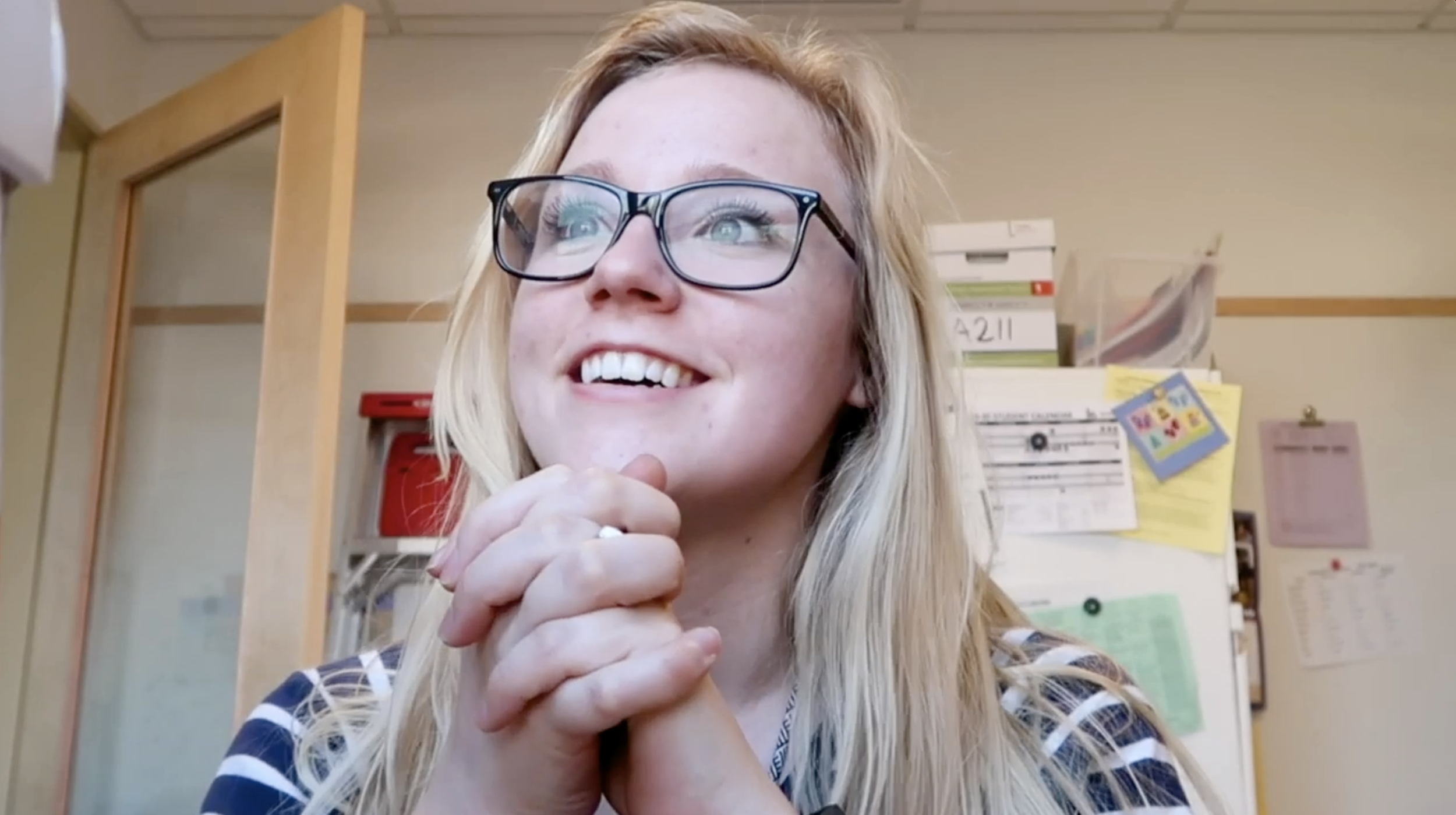
CO: I'm Cathleen O'Neill. I'm gorgeous. I'm Irish, female, fat and fifty. I've five kids. I'm here in
my life at the moment at kind of a transition. My kids are ready to fly the nest. The last two are on the edge, ready to get tipped out, and I've reached a lovely tranquil space in my life where I can look at things for me. So I hope my health doesn't fail me now.
MT: Can you introduce your work and SAOL?
CO: Ok. I'm the Education Coordinator here at SAOL. It's a community based rehabilitation project for women. It's a two year programme and it's unique in that it pays women to attend. It has an in-house crèche and it's based on the pillars of education and training, community development and political education. What's unique about it is that from its inception we called it a feminist project and that we had to deal with some flak around that.
We have very simple sayings. We say to the women, "This is a chance for you to recover, to find out who you are, to develop a future or to actually develop a progression route towards your future. It's a project where people believe in you. It's a project where you can heal. It's a project where you can look at the damage that was done, repair some of it, around family, children, community and we make all that possible." We get the women reinstated into community leisure stuff. They're all barred from shops. We look at the crime issues involved and we look at their charge sheets and probation needs. We get all of that squared off, so that they can be who they are. What we are not is an abstinence model. Weâre not a model that says you have to be drug free. You have to be stable and we accept stability on methadone, and you have to be heroin free. We don't necessarily want people to come down from methadone -- and yet that happens as a consequence of stability, regular norms, of being here, of the political awareness, the educational awareness.
After two years all of them have passed eight exams at two levels, Junior Cert. and Leaving Cert. Level. This present seventeen are taking a Certificate in Women's Studies. These things weren't in their vision. Now they're looking out. "Well I'll get a job after SAOL. I've been up early for two years. I've managed to keep it going." And they look at their lives then and the only thing stopping them is methadone, the daily attendance for maintenance. So a number of them give up the methadone. Which is really important for us, you know.
MT: How do you decide who's going to get to join the program? I'd imagine there's probably a lot more women trying to get on the project.
CO: Of course. What I havenât explained is that SAOL has a link to the city clinic where the methadone maintenance is given. Every two years we send an open interview process to them and everybody is invited to attend for interview. In fact, the first year fifty-nine attended for interview, of about seventy in the clinic. And in the second year sixty-three attended for interview. So we've an individual process. We are a collective. We do a group interview and then we also do a community reccy. You know, we just do a reccy with community people. We're not about cherry picking because we figure that if people are very, very able theyâll move on anyway. So we take some of course who need traditional supports, but we take the chaotic ones as well. And thatâs where the community reccy comes in, you know. Is this person serious about change or...? We have a three month probation period and if people really fuck up then theyâre off the programme. In fact, it only happened once, to one person. We havenât lost anybody.
MT: So you must be doing something right.
CO: Yeah. It's the feminist thing of supporting people, understanding where they're at. And when people do slip or fall we provide more supports, not punitive measures. You know, we go right in there. We say, "What was that about? Can you identify that? What do you need?" The women are great.
I used to say it was the best project in Ireland, but I've moved on. It's the best project in Europe. But you see, even when you do that jokey thing of saying to the women, "This is the best project," walking tall and dreaming big becomes a reality. We do believe in them and they know it. SAOL, because itâs feminist, because it's working with the women, because we do it collectively, because weâre a trust based organization, we end up in grief with the Health Board and with the agencies a lot of the time. The medical model is a very strict, rigid, linear model of seeing people as clients, and weâre the complete antithesis. We see people first. We see potential and possibilities and work from there. We're often in trouble with the medical model. We can't work with it. You can work individuals in the agencies but you canât change the medical model.
MT: What does SAOL stand for?
CO: One of the members of the management group is Seanie Lamb. He's a community activist. Heâs worked in this area for twenty-five years. And he's a Gaelgoir, he's fond of Irish. And himself and Joan worked on the name SAOL. And as a word "saol", S-A-O-L, it means "life" in Irish. And when you break up the acronym it's "Seasatacht, Abaltacht, Obair an Leinn." That means "stability, ability, work, and learn." And in a way too itâs a map. You know... you've a boundary. Stability, ability, work, and learning. So weâre stabilizing, weâre looking at peopleâs abilities, moving people towards work, and we're definitely providing learning. In the first two years of this project we got women who had left school, some of them before they were twelve. We got those through the first state exam of Junior Cert. and some of them through Leaving Cert. When that happened they took notice. The community took notice. Loads of affirmation came our way, to the point that the community has moved from being suspicious of women drug users to wrapping itself like a duvet around this project. They love us, you know. If weâre threatened in any way the community is right there for us.
MT: What is some of that background? When I saw your presentation at WERRC, I remember you touching on the subject of the drug marches that took place a couple of years ago.
CO: You have to understand that there are between eight and ten thousand drug users in the greater Dublin area. And the two key areas are the North inner city and the South inner city. Iâm based here in the North inner city and thereâs a huge plague, itâs an epidemic of drug use, heroin mainly, some crack.
The Concerned Parents Against Drugs were an organization that set up in the late 80s and they used to march on the homes of known pushers and known drug barons. And the gardai at that time shut them down and imprisoned a lot of the activists. And then when we reached the mid '90s -- and the problem is as bad again as it ever was -- Concerned Parents Against Drugs, those people and that political movement became known as the Coalition of Communities Against Drugs. Now some of it is political. Some of it is Sinn Fein. Some of it is the first traunch of Concerned Parents Against Drugs. And more of it, in this area, were people who are genuinely saying, "Enough is enough, we need to get the pushers out of the area." So they are a stand alone group.
ICON is the Inner City Organization of Networks. They became concerned about the direction those marches were taking and they began to get involved in steering them into a sort of a safer area. And they put some sort of boundaries around it; that they only marched on the homes of pushers, that they requested them to leave, that they'd work with the housing authority on evicting them, and that there be no violence, and that they were concerned totally with the pusher and not the pusherâs family. And they also put in place the fact that, "Addicts we care, pushers beware." So that they were willing to say, "Rehabilitation is something we work for in terms of the addictions but we want the pushers out." So ICON, for instance, were part of the setting up of SAOL. They set up a number of community based rehabilitation options. The Young Smokers Programme, the Crinnion Project and different projects for young people. But they were also, initially, involved in the marches.
But what began to happen was that after the marches, vigilante activity used to take place, people actually breaking windows and pushing people out, and ICON refused to be associated with it. So, for a time they tried transforming the marches. They held the meetings in the Church. I'll describe one, a typical one. Called by Concerned Communities Against Drug Addiction and ICON. A woman called Bernie Hard stands up -- her son had just committed suicide, hanged himself because of his drug abuse -- and she says, "There's no point in marching on the homes of the pushers when you've nothing for the young people, when you've no programmes." It was an arena for her to stand up and tell her story. Bernie is just representative of many women. And addicts themselves stood up, too, and said, "I am trying to give it up. I'm selling drugs to support my habit." Like, pusher-users. "I find it hard to give it up, I want to give it up." It became really a safe place for people to talk and a very important place. And I mean I went on the marches myself, where we tried to get the major barons out. We tried to get the scumbags out who were targeting young people and succeeded in doing that, but then the vigilante activity became something that you couldn't be associated with.
So what ICON did was, they continued to use the Church for the meetings, and they invited singers in. We had Francis Black in one evening, and megaphones all over the place and she was singing in support of the community. Christy Moore came another night and he sang in support of the struggle and the activism, the users, you know, and that transformed things. Brush Shiels. People then began to invite themselves in to the Church so Thursday nights were very special. And then a division occurred between COCAD and ICON, thatâs still being resolved to this day. COCAD still march, but not in this area predominantly. On the Southside and on the peripheries of Dublin. And theyâre scary, scary marches.
MT: How did you get in this work? How did you get from your work at KLEAR to SAOL?
CO: Ok. Iâm going to go back to the very beginning now and tell you that. One of the things that I noticed about KLEAR and that we began to document in the first six years was that a number of women who came to KLEAR, and who began to change politically, and who began to sort of take on board feminist issues, ran into trouble very quickly in their home. You know we were managing change and creating change and we were agents of change, but we werenât actually looking at the impact that was having, and men did not like it, children didnât like it, families didnât like it, and particularly the community didnât like it. So we spent the first five years doing the change, being agents of change, and I think the next three years managing the transitions and trying to bring people along with us.
So change was difficult for me and I ended up parenting my five children alone, as a result of decisions that I made. And that was I think an important point for me. And something that I think working class women donât talk enough about is when they step out... they step across a line. It can be punitive. What they leave behind can actually punish them, you know. And I think we need to talk about that especially. Itâs a world wide phenomenon. What are the politics of change and how do people manage change?
So I managed. I brought them all up, and as I said earlier Iâm at an oasis. Jaysus. I feel like Iâve just been given the key of the door, you know. So Iâm out there now looking for diversion.
From KLEAR to here... I was in Kilbarrack fifteen years and I stayed with the organization. And in ten of those years I was a fund-raiser, getting funds in from national and international agencies and that was going really well. And then we ran two training courses and people were skilled then in running classes locally and they needed to be let do it and people like us had to step back. So I took on board a Masters. I took an M.A. in Î94, which was brought about by a gift I got from the agency, KLEAR. We entered KLEAR in the Better Ireland Awards and we won first prize £25,000. And the group gave me £500 as a gift Îcause I did an eight page poem -- done over a bottle of Black Bush -- where I just looked back on the fifteen years and I looked forward to the future and presented the poem in terms of the people, the place, the process, the problems, and the product. This eight page poem did everything about KLEAR. We won first prize out of 600 groups nationally. And the money was used in KLEAR to secure our future because we were taking the Catholic Church to court. They wanted to take the building off us. And in the application, I said, if weâre successful weâll have a security blanket that will enable us to take the Catholic Church to court. In the end we didnât have to do it. But it was a time then I suddenly had money that Iâd never dreamed of, and where was I going to go?
And Kathleen Lynch in UCD had been watching me and saying, ãGood women like you now should be doing Equality Studies,ä but I didnât have a Leaving Cert. I didnât have a primary degree. I had nothing, except my publication. So we went to the Academic Council with the publication, with the research, with other things that I had taken on board and they saw those then as equivalent to and/or other qualifications. And suddenly Iâm on an M.A.-Diploma programme, safe enough. I thought I could manage a diploma and if my marks came back or, depending on the results, I could switch midway to the Masters, which is what happened. I did it full-time for a year, switched after the first exam straight onto the Masters, held a family council with my five kids, well four of them who are sort of articulate. Said, ãI have to do this. What will we do for money?ä Iâd been bringing in some money. My son said, ãDonât worry, Ma, Iâll look after you.ä Gorgeous. What was he? Twenty-five. He paid my bus fares and my lunches. Roisin undertook to do the housework and the lunches and keep the house ticking over. And they all said theyâd support me around the study. My son went a step further. I had taken a journalism course a couple of years earlier and became computer literate but only on Macintosh, an Apple Mac. And he said, ãNow mother, how are you going to manage all these essays? How are you going to manage this?ä He said, ãWhat computer do you understand complicitly?ä I said, ãThe Apple Mac Classic.ä He bought me one. Arrived up, put it in the bedroom, resourced me, got me files, got a database going and that kind of stuff. He really believed in me, you know. I got a lot of support. So I took the M.A. I left KLEAR to take the M.A. and three weeks after that year finished in UCD I applied for this job and got it.
MT: And was SAOL a pilot project at that point?
CO: Yeah.
MT: How had you heard about it?
CO: Joan had been employed as manager from the May of that year and she was looking around for people. She put an ad in the paper, and as she was putting the ad in the paper her friend said, ãI know someone whoâd be ideal for here.ä Joan said, ãTell her to apply.ä So I did and I got the job. But all I did was, I transferred the principles and the process around adult and second-chance learning, personal development and political development here. Joan said, ãI donât know if this will work.ä I said, ãJoan, let me do it, let me do it, this will work.ä She admits herself that processes are important. Because what youâre offering people is equality of respect, equality of condition, equality of opportunity and equality of support, and equality of outcome then is their gig, and it happened.
We decided that because it was a pilot project, because it was women only... Again, remember itâs my second time to be involved at the birth of something. Iâm saying, ãJoan, you need to take a high profile here so that the women who come here believe in themselves and the community believes in them, because youâre taking women in who have no self-esteem, who have no self-belief. We need to do that for them, until they believe it.ä So we took a deliberate high profile. Nothing but the best for the working classes and we brought in the best tutors, the best resources. And we could because we were a pilot. And SAOL was a phenomenal success. But again political stuff, taking on the agencies, taking on the Health Boards, taking on the State, all of that goes in tandem with the processes, and Iâd know that from my experience so Iâd expect it.
MT: Why did the community decide to focus this project on women?
CO: One of the community welfare officers in the Clinic was looking at the number of women who were presenting for treatment. It became apparent that the biggest problem was that, having given up crime, having given up stealing and shoplifting to support their habit, they were left with very few options about filling in their time. They had nowhere to go with the children, they didnât know what was available. So she had to talk about her research, about what they would like to do if there was anything for them. And at the time the women came up with sewing and knitting and crafts, because theyâre safe. And Joan was presented with this. The City Clinic looked at funding. ICON looked at funding. Seanie Lamb ran with it and got the funding for the project. And when I was employed it was to do sewing. And I said, ãJoan,ä on day one, ãItâs not going to happen, you know.ä She said, ãYouâre right.ä
So we became an education and training agency ourselves. Carmel Dunne did up the research with I think fifty women, and they all said yes they would go to a course, yes they would like to do something around crafts and maybe basic literacy. And Seanie approached the training agency to run a special project, a two year project and the women get a training grant of something like eighty quid a week to be here.
MT: And how did SAOL then get funded for a longer time after the pilot was over? Were you still in the pilot phase?
CO: We were funded from a number of different agencies. Funded by the Health Board, funded by FAS, the national training agency, and Joan got some funding from the EU Social Exclusion funding, which enriched us to take a lot of risks. Like, our first sort of public outing was the launch of a book. You go with what you know. You go with what works. The first class I ran here was a creative writing class, and we set up the Cardboard Box Writers Group, because all we had were pens, papers and cardboard boxes. We didnât have chairs. We had the radiators. The radiators had come in cardboard containers and we put the radiators across the chairs and used those. So it became the Cardboard Box Writers Group. And our first publication was called Resolute Women Recite. So that was our first public outing and as I said Joan got funding from Europe. That enriched us to do more of that work. Taking the high profile work.
At the time in 1995-96, the National Drugs Strategy Group had been established by the government to take a strong line on drug rehabilitation so weâre using that politically as well, and they had us front a number of their conferences, speak to a number of different agencies. We let the women do it. We took the women out. That was such a simple thing to do but it was so unique for these guys. And they were bowled over by that. So the project, even in its first two years, got ministerial attention. So they were on board. The Health Board was clearly on board. We were working. But myself and Joan also applied to Europe for a NOW programme. So we ran the second year. We enriched it again with a NOW programme which finishes in December and weâve been assured of our funding for the next two years. But more than that. At a recent launch of a partnership publication, the minister responsible for drugs has said that if he had a wish to mainstream two projects, it would be SAOL and another local one in the community after school. So I mean, if they talk about mainstreaming it, in its present shape, weâve won.
MT: Do you think thatâll be good? Mainstreaming it?
CO: We wonât let them change the processes or any of that. Iâm on a contract so it might be a job for me instead of a contract and Joan the same.
MT: What are some of your favourite projects that the group has taken on?
CO: There were a number of different projects established here and Iâll emphasise again, itâs done in the collective, itâs done by a group-work process. The first project was the writers group and theyâre on their third publication now, Resolute Women Recite, Powerful Women Recite and the last one we called Women in Action. And getting much more sophisticated altogether. Weâre more skilled, women are more used to it. We also network vigorously with the key group, and one of the groups thatâs important to this project is the Penal Reform Trust because theyâre trying to change the fact that women end up in prison because of their addiction, and not because of their crimes And we linked into the Penal Reform Trust, trying to overhaul the prison system, the sentencing system, and we became involved with them and went to a number of conferences, addressed a number of conferences and then got tired making papers all the time. You get tired of making the issues, you get tired of making the analyses, so we decided weâd set up a speaking choir which is something that I saw in Belfast. I have a son whoâs profoundly handicapped and I saw young men and women doing a speaking choir, taking speaking parts and modulation and emphasis and rhythm, and making the same points as what we needed to make. So we came back here and we set up a speaking choir ourselves. And we addressed the national conference of the Penal Reform Trust with a piece called ãPunishing The Poor,ä Îcause we figure that theyâre either punished for their addiction or their poverty, women.
So, again, itâs process. Itâs the process. Women learning to speak for themselves, to do it in a really good way and writing up the issues for themselves. And we had a quilt project. We decided that weâd make a quilt for the first programme. We always look at whatâs there, and whatâs there at the moment are quilts that look at the people whoâve died from HIV or AIDS. And we decided to transform that and look at people who were living after drug use, and who were living with HIV, and who were living with AIDS, and we did a Life or a Hope quilt. And that, just even the politics of getting there are important. So the quilt project was a major success. We have it inside.
And our next one came to us -- we got a call from an artist whoâd been to Mexico and sheâs working with the Zapatista community. Do you know anything about them? Itâs a community in Mexico that are trying to hold onto their ethnic origins and their own culture and reclaim land and, you know, just honour their daily customs. And they meet a lot of resistance from the Mexican government, in much the same way as our Travellers get moved on. Their men have to go into hiding because theyâre regularly targeted by the Mexican army. And Iâll give you an example of how theyâre treated. The women developed a mural telling the story of their struggle in a mural form and even as the mural is being developed the army is defacing it. The same thing happens in the North of Ireland, you know. The RUC defacing murals in nationalist areas. But thereâs a solidarity movement around the murals now. Thereâs a mural has been replicated in Madrid and we've just finished replicating the mural here but like... because it's SAOL, how can we transform this? How can we do a mural that we can get to them instead of just holding it here? So we put our mural on thirty metres of canvas and we now have a portable mural which weâre sending over next week to the Zapatistas, in solidarity, complete with a videotape and an audiotape of our response to their struggle. And weâre trying to get diplomatic support for it so that they wonât refuse to take it at the customs, or they wonât deface it if we get diplomatic support. Itâs our mural, so in a way weâre really supporting their struggle. And the women have worked on it consistently for the last three weeks and itâs an incredible piece of art. Then we end up with the video and we end up with the mural, you know, ourselves, so itâs a good project.
MT: God, I hope it gets through.
CO: It will, it will. Weâre going to get a bit of support for it. And if they touch it, Jaysus.
MT: Theyâre in big trouble with Cathleen OâNeill.
CO: So all I can say is process, process, process, support, flexibility and a women-centred way of working is, is central to this organisation. The best workers in Ireland, as well. And Joan, under her hands, under her leadership, anything is possible, because she trusts her people to do the work, you know. She doesnât cramp your style. New worker in the budget, Marie Mulholland, made a very smooth transition, good addition to the project, expect great things of her. I canât think of anything more to say.
MT: Iâve got more questions but itâs 4.10.
CO: Ok, shoot the questions. Iâll try and confine myself to answers.
MT: Iâm interested in your personal story. In what inspires women. I mean you were just one of a group over in Kilbarrack but not everyone took the same path that you did. What has inspired you along the way to do this sort of work? Have there been other women that have been monumental in your life?
CO: The original founder group of KLEAR were five working class women from the Kilbarrack area and I came along. The thing that we all had in common was we were questioners, we werenât happy. We had a passion for change. My big thing was, ãI canât spend the next thirty years coming up and down these stairs making beds. There has to be something more in my life. There has to be more than just talking about children.ä You have to remember too, that 1980, weâd had ten years of the second wave of the Irish feminist movement and in Ireland it took particularly public debate. Because a lot of the founder members of the second wave were working in the media, we were very lucky to quickly get access to the debates and to the issues. I spent the late Î70s going around the Housing Action Group and listening to what was happening and buying the books so I was already unhappy.
I told you that I was a feminist from the age I was seven and I didnât know it. So I spent my life... I spent from the age of seven until I was twenty-seven in a rage. And my mother never knew what to do with me because I was never happy, I was always trying to change things and I questioned everything about, ãWhy couldnât women have a pint? Why couldnât I go to a fleadh ceoil? Why couldnât I? And why did I have to get married?ä I was in feminist struggles, from age seven.
My mother... Iâm the eldest of thirteen, so thatâs an important thing for you. And my Dad was in the British Army. He fought in the second world war and he lost a limb in the second world war so he couldnât work. And my mother had a huge task to bring us up in a very, very working class estate in Ballyfermot. And my mother always took the road of least resistance. ãDonât bring any trouble to the door. Donât speak up for yourself. Donât bring notice on yourself.ä And sure I resisted that from the minute I was born. ãWhy, why, why wouldnât you speak and be strong, Ma?ä ãYouâll only end up in trouble.ä Her overriding concern was to keep us safe. She didnât want rebels and radicals going off. By time I was seven my mother had myself and Rose and she had two sets of twins ok. So thatâs six of us. And because my dad had a British Army pension, he couldnât qualify for the early sort of social welfare thing of the Blue Card. A Blue Card got you attention at a dispensary. It didnât get you the medicines, but it got you to see a doctor who would diagnose whether you were very sick or not.
One of the twins was very, very sick and my mum walked three miles to the dispensary. And was trying to get in to see the doctor, but she didnât have the Blue Card because she didnât qualify for it, because we had about three pounds more over the odds, due to the British Army pension, that my dad got. So we couldnât qualify in the Irish State for it. I think there was a bit of national stuff going on as well, about the government not giving ex-British soldiers benefits. So she went up and she tried to get in to the dispensary to see the doctor. Now one of the twins was seriously sick. I remember being really concerned. She wheeled one pram and I wheeled the other pram and when she got up there, again, she just never was able to challenge. And she said, ãI need to see the doctor,ä and the porter said, ãWhereâs your Blue Card maâam?ä And she lied very badly and said that she couldnât find it or she didnât have it. And he said, ãWell if you havenât got a Blue Card you canât see the doctor.ä And I looked at him... And I always think of myself that when I was seven I was really a hundred and seven. I feel that I lived my life with foreknowledge and foresight, you know. I was a hundred miles away and looking at this and saying, ãHeâs not going to do this to her. Iâm not going to let him.ä So I said, ãMy mother will see the doctor. Sheâs here to see the doctor. Donât stop me mother, right.ä And instead of supporting me in my little struggle my ma said, ãGet outside, you. Iâll talk to you later.ä And she hit me. And when she hit me I ran at the porter and I said, ãLet me mother in to see the doctor. Just let her in. You donât know whatâs going on. You donât know how sick they are.ä But he wouldnât and me mother says, ãWell thanks very much,ä she says to him and she walks away. I was furious. I was fucking furious. And thatâs the day I became a feminist. I know I did because he was the porter, he was a male, he wouldnât let her in to see the doctor, and he negotiated the health of my motherâs kids.
Well this is what happened. I went off and me da said, ãWhatâs wrong with you?ä I was known as the Big One, you know, and I was a very skinny child. But I was always known as the Big One because everything around me was a big issue. And me ma came and I got pushed in the door and me ma says, ãTake her away from me.ä And he says, ãWhatâs up with you?ä And I told him and I said, ãAnd the worst thing is that she hit me.ä So he didnât say anything for a long time and later on that evening he came over to me and he says, ãI like what you did,ä he says and he gave me a half a crown. ÎCause he could see. He could always see what was going on for me ma you know.
So, in school I got into trouble. I have to say that the thing that made all my challenge possible was I read and read and read voraciously. And when I was a child between the ages of seven and ten I was in two public libraries. Me da was off the wall bright and me da, me da never censored anything. Like, I was reading I Claudius as a child, you know, because he was reading it and heâd said, ãYou should read that.ä So I was in two libraries Îcause you could only take out so many books a week. Imagine! And I remember one librarian taking an interest in me. I was in one in Emmet Road in Kilmainham and I was in one in Thomas Street. And the reason I was in one in Thomas Street was I used to have to go to the pawn shop twice a week. And Iâd have to wait, make your pledge in the morning and get your money in the afternoon, and you just spent the time in the library. I went to the librarian one day. ãIâve read all those books.ä And she knew well I had, she knew well I had. So what she did was, as a ten year old, she gave me access to the young adults section, and she began to look out for books for me. So I got a mentor. And from the age of ten till fourteen I read books that nobody was getting access to. And sheâd say to me, ãWhat did you think of that?ä and Iâd give her the feedback.
So I had, I suppose, a political awareness, and also when I was fourteen, near where I lived we have Kilmainham Gaol. And a call went out for volunteers to restore the gaol because there was a whole big thing about would they knock it down or would it be restored. So a voluntary group got set up to restore the gaol and I became a guide and a volunteer there between the ages of... from fourteen till I got married. I did a training course in the history of it and had a lot of nationalist knowledge and a lot of political information. I worked there every Sunday and ended up being a trustee of Kilmainham Gaol.
I left school. Big story here, left school, got the highest marks in the school for what they called the Primary Certificate and based on those results the Mercy nuns gave me a scholarship. Fuckers. Gave me a scholarship at the time when second level education was fee-paying. But they didnât give me the uniforms or the books or the money for the typing and all of that and I ran into trouble in my first six months and I left the school because of one and sixpence. There was a fucker of a nun, a hoor of a nun, an absolute hoor of a nun, who used to take me on every Saturday morning. You had to go to school on Saturdays as well, five and a half days a week. Saturday was business organisations and book-keeping and office skills and she was after me for three months for one and sixpence for typing paper. My mother was out the door. She had cobbled together from second-hand shops what she thought was a uniform. It resembled the uniform of the other girls only in its colour. It was a gym-slip and I was a sore thumb anyway but I was managing all that. I was keeping up with the work. But I got up one morning and I said, ãSheâll be after me now for this money,ä and I knew I couldnât take it. So when she said it to me, I was only in and she targeted me I said, ãWell, youâre never going to get it now Îcause Iâm off.ä
MT: And how old were you then?
CO: I was fourteen and it was unusual for anyone from that area to go to a fee-paying school, to take second-level education. So for the next six weeks the head nun was up and down with me da, up and down with me, but I wouldnât go back. And that summer I got work in a sewing factory. Still kept up the reading and I had Kilmainham Gaol. In fact I was twelve when I got the scholarship and thirteen by the time the summer had happened and the first six months were over. I was thirteen and I got a job in a tailoring factory. Three and ninepence a week. I stayed there until I got married. Iâm going to draw a merciful veil over the next fifteen years. They were horrendous. I had five gorgeous kids, a really bad marriage, which I ended in 1983. My twins were a year old, my two daughters were eleven and twelve and my son was fourteen and I ended it. And we had a fairly difficult decade, itâs over now thankfully.
MT: And now youâre here at the oasis.
CO: On the cusp.
MT: Iâm just gonna ask you again about any women along the way that might have inspired you or any heroines you have now. Any women that stand out?
CO: Yeah. Immediately Iâll say Kathleen Lynch from UCD who believed in me from day one, who took on the academic council. She would definitely be important for me. I would think Ailbhe Smyth would be very much up there as well in terms of her own struggles and in terms of her political ambitions around WERRC. Sheâd definitely be there for me. Ronit Lentin in TCD is an important person for me around process and analysis. But the most important person in the last fifteen years has been a woman called Patricia Kelleher. Patricia came into KLEAR in in Î85 and she did a feasibility study. She came to the management group and said, ãCan somebody from the organisation work with me on the feasibility study?ä and nobody would take it on and Iâm the risktaker and I said, ãI wouldnât mind.ä She was a good mentor around poverty analysis and the feminisation of poverty. She became very important to me. And she also supported my application to Combat Poverty for the Telling It Like It Is project. And she supervised that project for me. So her integrity was an important principle for me. And I just learnt from her. Every time Iâd meet her sheâd have a different analysis and sheâd challenge me all the time. So she was important.
There are three women from the original founder group in KLEAR who are fundamentally important. One is Carmel Jennings. I just love her dearly. Sheâs in Australia. She went to Australia in Î89. She couldnât contemplate bringing her kids up on the dole and it was bad in the Î80s here. So Carmel is out working in Ad El Ded. Carmelâs belief in people, her integrity around literacy, her respect, and the fact that she never let one adult down, sheâs a role model. Angela Mulligan is another founder member. Sheâs so passionate. I mean, sheâs passionate about a cup of tea. Everything about her is passionate and she just couldnât stand injustice, so she was important to me. And then between the two of those is a real reasoned, balanced woman called Jo Reilly and Jo is just... Her analysis is so pure. She was a dream to be around. They inspired me.
My daughter Roisin. She was about fourteen when I put my husband out. It was after a year or two when heâd left and Roisin always had an inner eye. Sheâd a third eye. She could see struggles. And she came up to me and she gave me a plastic card, you know a fridge magnet, and it says, ãWhen the going gets tough, the tough get going.ä She gave me that and says, ãMa, youâre amazing, Ma.ä Real red face. ãYouâre amazing, Ma.ä I said, ãWhatâs all that about?ä She says, ãWell, we were asked to do an essay in school.ä She was doing her Junior Cert. ãAnd we were asked to do an essay on heroes.ä And she says, ãMa, youâre my hero.ä And the whole process of the essay and the feedback she got, she bought the magnet. And she really kept me going. A very dodgy year for me and she kept me going. Roisin always believed in me. So theyâre my heroes if you like.
MT: Iâm asking every woman that I interview about their first name because I think that womenâs first names are so important. Our last names always get taken from other people somehow and theyâre not quite the same. So I was wondering if you were named for anyone in particular, and how you feel about your first name?
CO: My mother had a child before me who died and she had a very, very difficult pregnancy when she was carrying me. Her delivery was particularly difficult. And she named me after the woman who got her through the delivery. My mother was fierce impressed by her, fierce impressed, and she called me after the midwife.
MT: So I guess you really like your name.
CO: There's a debate in our house about my name because in the early '80s, when I put my husband out, I didn't want to use his name and didn't want to use me da's name. So I had a meeting with the kids. We got through our lives with family meetings. We had the most amazing meetings where I got challenged every week. Like, I'd challenge them and theyâd challenge me. But one of the meetings I says, "Hey kids, I think Iâll have to do something about this name. I'm not happy about it." So we had a ball. And they said, "What do you want to be called?" And I said, "I want to be called Cathleen. I mean just my name." And that became Kate Just. I thought I could try that. And Derek looks at me and says, "Well if you're going to be Kate Just, I'll be Derek Of Course." I never did anything about it you know, but we'd good fun about the name. I kept the name because everybody knew me by then you know. Actually he has no role in my life. His name is nothing. It's me kids' name.
MT: Right, so thatâs who you associate it with. The other thing that just came into my mind when you were just talking about the '80s were a really hard time and I was thinking how everyone that talks, since I've been here, says Irelandâs doing so well, the economy's doing so great, Celtic Tiger, blah, blah, blah. But I kind of don't think that's really an accurate picture of what's been going on and you've certainly been working in the sectors that have seen whether or not this big boom is really trickling down.
CO: It's a boom. The economy is wonderful and the people who are accessing the boom are people who are educated, people who are winners and victors in the first place. Working class people aren't educated. They don't have the credentials to be victors in it. A recent ERSI report came out to say that there is as much poverty among women and children in Ireland as there was in the '80s.
I'll give you one example. The last Minister for Education decided to give access to third-level free to everybody. So a millionaire's son could get to third-level, but a woman or somebody who's working part-time can't get third-level education free. It's not part-time, it's full-time. They haven't done anything about large class sizes, they haven't done anything about primary schools or literacy levels. They have one hundred and fifty thousand adults in Ireland with serious reading and writing problems. Now I think they should do what they did in Cuba and close down the universities until every adult can read. We have as much poverty, I'm convinced of it, it's hidden, it's feminised, but it's there, as we did in the '80s. I mean, the economy is burgeoning right enough, but it's immigrants who are returning home who are getting the jobs, who are resourced in the first place educationally, you know. Our women certainly, the women here in SAOL, they're young women, largely twenty-five, twenty-six years of age, they're early school leavers -- how can they access this economy unless there's serious, serious positive discrimination, you know? Schools. At the present moment, as we speak, schools in this area have between thirty-five and forty students per classroom. Theyâre leaving school with reading and writing difficulties, with confidence difficulties. They're not taught to believe in themselves. Itâs only in the last curriculum year that we have civics in school. People are leaving school without a political education, a political awareness, civic awareness. Only in the last year has it gone on the curriculum, thanks to groups like KLEAR pushing for it.
MT: Thanks so much. I really wanted to get your perspective on that because I don't have anyone really talking about that much. Itâs disturbing. One last question: with all your time with community writing groups, has that made your own writing suffer or are you still able to be creative as a writer yourself?
CO: I think that ... I'm teaching full-time. I teach all the time. I donât just teach creative writing. I teach personal development, political education, personal effectiveness. I'm teaching all the time. And I'm teaching the people who didn't access primary education very well. So I feel that I'm creating and creating all the time. It has affected my own writing. I managed the book. I still write poetry. My thesis on SAOL was, I think, the second book. I might publish that. But if I ever get the luxury of time to myself, I could still produce stuff, so I am ok about it. I think that I will write. There's certainly a number of stories I'd like to write... I'll tell you one story.
In 1984, I had a nervous breakdown, right. Public. Theatrical. Spectacular. So healing. Letting it all go. I'd this wonderful, wonderful rant for about six months. The cause of the breakdown was that one of my twins, undiagnosed at the time, was autistic. He was clinically hyperactive and he had a mental handicap and we werenât aware of it. He was still on the breast but he wouldn't sleep. And after eighteen months of sleep deprivation I had this nervous breakdown. But I used it well like, as everything in my life. I had this rant about equality, about feminism, about womenâs work. All the reading that I did came out in this nervous breakdown. And I ended up in a mental hospital. It was also the year I put my husband out. Right, it was also part of it. It was a good move that was. They have a saying in Ireland, "She's mad with sense." This was the truth of it. I put him out and then nine months later I had this breakdown and ended up in St Itaâs in Portran. And then I decided that I'd have a feminist breakdown. All the men who came to see me were psychiatrists and they were all... men. And I sacked five of them over a month. One fella came in, in the white coat and he was an old... he was asking me these questions and I said, "Who's that behind you?" You know, the observer. Thereâs this technique where one guy asks questions and another one sits in the corner. And he said, "Oh, he's just here to observe." And I said, "No, sorry, he's just here to observe me. I'd like to have a say in this." And he referred everything back to your man because he was in the observer role. I says, "You're sacked. No fucking good." I'd had a week of narcosis, a week of being asleep and I'm very seriously ill but I still had this spark left in me, this life thing. So I sacked him.
The next one looked at his watch. I said, "It's clear that I'm keeping you from your business," and I sacked him.
The third fellow got sacked because I decided to try a different approach. I said, "Look, can we agree the topics for discussion today, because I don't like answering your questions, I don't like where they're going." He was a Kerryman. He hd a real difficulty with that. Fucking sacked him.
And the next one, he says to me, "Do you believe in God?" I said, "Sorry, it doesn't work for me," and we had a debate and I sacked him.
On my last week there this guy came up to me in, the director of the mental hospital. He came up and he says, "You've sacked all me staff. I'm a bit intrigued about this." So I gave him the whole story. Without demeaning them in anyway, why I sacked them. And he said, "Well, I'm the only one left and I'm really interested in working with you," and he said, "Will you give me a chance?" Yeah, so his approach was different. "Well, let's have a look at this," I said, "Talk to him." And after a number of sessions we had a big, big row because he said, "The problem with you my dear is you are too bright for your social class." And I says, "That's grand," says I, "And have you loads of room here?" He says to me, "Why would I need room?ä""And I says to him, "Well my friends are clearly on their way in. They're working class," I said. "They're off the wall bright as well." He accused me of being facetious and I accused him of being... We got into a eugenics debate and I stood up and he says, "I'll say it for you," he says, "I'm sacked." And I says, "Yeah, but you're vigorously sacked, fucking furiously sacked," for that one.
He said he would see me again, that Iâd be back. I said: "No. You will never see me again." And I meant it. And he didn't see me again in that capacity. Because of course I'd had enough then, I'd had a break, Iâd got sleep. I was well able to go back into the kids. Three weeks after leaving that mental hospital they gave me a diagnosis for Sean that made such good sense -- that it wasn't me, that it wasn't poverty, it wasn't any of those things that made him difficult. It was the fact that he had a moderate mental handicap, he had a level of brain damage, and he was clinically hyperactive.
So I said, ãThis is a problem that we have to deal with.ä Called a family meeting. And we decided that weâd manage Sean. The issue was would I put him in an institution or would I keep him. We kept him.
My son at the time was 14, Sinead was 13. And Roisin was just going on 12. And the twins were a year old. And years passed. Derek finished school. He started college. He started to go out with girls. He brought this lovely girl home to me called Susan that really was an instant hit with us. All his girls were but this one was a complete instant hit. And after two years of the relationship, motherâs day was coming up, he says, ãMum, I want to bring you out for lunch, I want you to meet Susanâs parents. I went to the old Sheiling hotel, walked into the lobby, all dressed up, in the good suit, you know. And he says "Mam, this is Susan's mom and dad." And he [Susan's dad] stood up and he says, "I know you." And he says, "I've been watching you for the past ten years.ä It was your man. Because of the public profile around Kilbarrick and the divorce referendum, and all of the different campaigns, he had known who I was and made the conneciton with Derek. But I had never made the connection. And to his credit, he had never never influenced in any way. And he had only one child, that was Susan, and my son married her two years ago. Best wedding I was ever at. Good, isn't it?
MT: So did you turn it into a story?
CO: No, I didn't, but I have loads of those stories in my life! I'd say it'd make a great movie. Because when I said to Derek, I said, "Get me out of here," and he says, "I will not, Ma." Susan says, "Don't worry, this happens all the time, my dad knows loads and loads of people." I said, "He doesn't know loads the way he fuckin knows me, Suz!" She's roaring laughing. Anyway, we decided that we'd have the lunch. It was very pleasant, if strained. What I love about my son is, that night -- he didn't tell me but that night -- he went down to Mr. McGuinness and he says, "I wasn't aware that you knew me mam." Cause Derek knew how public and theatrical this was. But Derek says, "What do you think of my mother now?" And he said, "I think your mother's done amazingly well. She's responded to all of the challenges. And she's been challenged bringing you all up, and she's done it well." He said, "I think she's amazing." So he obviously said the right thing. Derek never said that to me. McGuinness said that to me the day of the wedding. Good story. Major big house on the sea front. And me five minutes up with the corporation house. Pushing her every barrier and boundary in the world.
Ok. So that's who I am. I'm anything I want to be but I'm really at peace with myself at the present moment. Turn it off. I'm finished. Good story.